

Caption: Overall winner of the spring 2026 Charles J. McClung Speech Contest, Ariel Soudry, delivers his speech, The Great Emu War.
Public speaking can be a daunting act for many students, but those who conquer their trepidation and participate in the School of Communication Studies’ Charles J. McClung Speech Contest find the reward for their courage is an enduring confidence in themselves—and a little scholarship money.
For decades this speech competition has challenged students from all corners of campus to step outside their comfort zones and give it their all on stage in front of hundreds of their peers. Students taking CMST 210 Public Speaking are required to be in the audience for the final evening of the competition, which is held in the fall and spring semesters. As VolCore requirements state almost all University of Tennessee, Knoxville, students must take a public speaking course, that means the audience for the competition these days is usually more students than can fit in the 1,000-seat Cox Auditorium, making the contest the largest of its kind in the Southeast.
An Origin Story
The Department of Speech Communication, which predates today’s School of Communication Studies, had held speech competitions throughout the decades. But by the time Associate Professor John Haas became department head in the mid-1990s, the department was struggling and no such contest was offered.
A public speaking contest for students in public speaking courses was resumed shortly after Haas stepped into the department head role—a promotion that happened the same month he earned tenure almost 30 years ago. Undaunted by the fact he was half the age of the faculty members he was managing, Haas said he was determined to not let the small academic unit fade into oblivion.
“When I first got here, I was really afraid the administration would kill speech communication, it was not a strong program,” he said. “And I did not want to be the last head of the Department of Speech Communication, so I wanted to build it out. A university like this must have a strong communication program because communication impacts people in so many ways; you can’t have a major land-grant institution without having a strong communication program.”

Initially the contest allowed students to speak on any topic, and winners were chosen by the level of audience enthusiasm, which was arguably a flawed method often resulting in students packing the audience with boisterous allies. At the time, there were about four of five public speaking sections within the Department of Speech Communication, and the contestants would meet to present and compete in an auditorium at the old University Center, which alumni of that era may recall was next to the candy counter.
While Haas could romanticize the modern-day contest’s origins, the unvarnished truth is that the Charles J. McClung Speech Contest grew because of two events. First, UT adopted a general education program in the mid-1990s that required all students to complete one course in oral communication. Second, there was a benefit originating from UT’s accreditation review by the Southern Association of Colleges and Schools Commission on Colleges (SACS). At that time, UT didn’t have the global presence it does today, and many of its students had never stepped foot outside the state, much less the country. SACS had mandated the university to create programs to expose students to more international and intercultural topics.
“We were mostly getting our students from between Nashville and Johnson City, and we weren’t pushing study abroad. It really was different time,” Haas recalled. “That’s part of why we started the networking trips a long time ago—to take them outside of Tennessee.”
But there was a hiccup in meeting this accreditation goal: changes in university administration led to a shake up that ousted some people out of their roles at UT, and when one such administrator departed, so did the accreditation review plans.
“We were coming up on a SACS review where we had made commitments, and we didn’t have anything to show for those commitments. So, the administration turned to speech communication, English, and math, and said, ‘What can we do to show that we’re meeting this commitment?’,” Haas recalled.
That’s when he, a tireless proponent for the value of public speaking, pitched an idea that would be the genesis of today’s McClung Speech Contest. He proposed both a way to make the contest fulfill the requirement, and a way to perpetually fund the production of a larger speaking contest. In the 1950s, the department had held a stylized speaking event called declamation, funded through a donation from the same McClung family whose name is on two campus buildings. Declamation was an outdated style of competition that no longer existed, so Haas suggested the funding go towards a new speech competition that would require students to speak on an international or intercultural topic.
“If the three units involved had not added international/intercultural content to courses , we would have had nothing else to report. There was no other effort made across campus to meet that accreditation commitment,” he said.
Thus, the horizon-broadening Charles J. McClung Speech Contest—which would evolve into a huge event engaging generations of Volunteers—was born.

Empowering Volunteer Voices
While the competition originated from necessity, its purpose was always to give students the opportunity to push themselves and discover their capabilities. As someone who was a very shy child, Haas knows first-hand the confidence public speaking can instill in those who master it.
“I was giving a presentation at school, and I was speaking with a strong voice, and people were interested; that’s something I felt was empowering, that I was able to influence others and make myself be known,” he recounted. “As I went to college, when I was working in groups, I would be picked to be the person to speak in groups. When I want to graduate school and started teaching, I thought, ‘Man, this is a gift from god, I get to talk and they have to listen.’”
Haas has spent over three decades passing on that gift to thousands of students who have sat in his classroom—many of whom competed in the McClung Speech Contest, such as College of Communication and Information (CCI) alumna Amy Donahue (’09, ’11).
Donahue said there have been countless times in her professional life when she’s utilized the public speaking framework she learned as an undergraduate, including in her current role as assistant vice chancellor of communication and constituent relations for the University of Tennessee, Chattanooga.
“One of the really interesting things now, being very many years removed from that initial course, is the framework that was taught has been so useful throughout my career,” she said. “It’s what I used in the course, the speaking competition, and the framework I use now if I’m having to put together public comments or presentations for myself or write for someone else who is speaking.”
While everyone who takes a public speaking class at UT can walk away with the same knowledge Donahue has found so useful, not everyone is privy to the self-assuredness gained by being a McClung Speech Contest finalist. That can only be attained through a process that starts with an instructor nomination followed by several rounds of judging—first by fellow students, then by a panel of UT faculty and staff, culminating in the selection of five finalists.
When she was nominated to compete during her first year at UT, Donahue didn’t think twice about accepting. It wasn’t just an opportunity to win; it was a chance to prove herself as a rural Tennessean up against fellow undergrads who likely had attended high schools with more intense academic programs than her own.
“Could I come to UT and really compete with other students who had more opportunity than I did? One of the wonderful things about this competition is it gave me an actual opportunity to do just that, that semester in public speaking, with a huge cross-section of students from campus and an incredible variety of majors,” she said.
While the most competitive part of herself still rues the fact that her speech on the different types of muscular dystrophy resulted in her being first runner-up versus the overall winner, Donahue said the experience was invaluable in proving to herself that she had the chops to compete against UT’s best.
“I was able to come in and not only perform in the classroom but against all the other speeches to be picked; then to perform that night and do a good job and place highly gave me a lot of confidence. I thought, ‘If I can do this, I can be successful.’,” she said.

Fast forward to the 2020s and not much has changed with the McClung Speech Contest except the audience: it has grown alongside climbing university enrollment. Current CCI master’s student Katherine Newman said she can still recall how the bright stage lights illuminated hundreds of her peers’ faces when, as an undergraduate, she stepped onto the stage to deliver her overall winner (tied) speech on how to use social media to plan international travel.
“I could see everybody and it was really crazy to look out; it was nice because I liked seeing people’s faces, but it was like wow, that is a lot of people,” Newman said, but added that she’s always been a confident public speaker and her excitement about the topic overcame the few nerves she had fluttering.
While naturally inclined to the medium in a way most people are not, the master’s student said she still looks back at the competition as a barometer for her abilities. If she’s feeling unsure about a daunting task, Newman reminds herself she once gave a winning speech in front of 1,000 people.
She’s also discovered the ability to write a good speech aimed at a target audience translates seamlessly into creating content for social media—knowledge she uses regularly at her UT Athletics internship as a social media coordinator for the Lady Vols.
“Being able to present my ideas in multiple different ways has helped a lot. Public speaking has taught me about knowing my audience, and that has helped me a ton in all areas of my life, even something as simple as friendships,” she said.
While some interns could be intimidated by the high-profile and high-pressure situations that can occur in an SEC university’s athletics program, Newman said the more she uses her communication skills, the easier it gets. She said that the speech competition and everything she learned in her internship and studies have prepared her to tackle the next steps of her professional journey once she graduates this May with her Master of Science in Communication and Information with a concentration in Strategic and Digital Communication.
A Competition for All Vols
Though Newman and Donahue both graduated with majors from CCI, most McClung Speech Contest finalists and audience members are from other colleges and majors. This spring, the five finalists and their speeches were:
- Overall winner: Ariel Soudry, The Great Emu War, finance major at the Haslam College of Business, winner of a $200 scholarship
- First runner-up: Hailey Solomon,The Cultural Factors Behind Costa Rica’s Blue Zone, nursing major at College of Nursing winner of a $150 scholarship
- Marlie McLellan, Italian Coffee Culture, management major atHaslam College of Business winner of a $100 scholarship
- Grace Sullivan, Chinese Street Food, nursing major at the College of Nursing winner of a $75 scholarship
- Coco Allen, Día de los Muertos, microbiology major at College of Arts and Sciences winner of a $50 scholarship
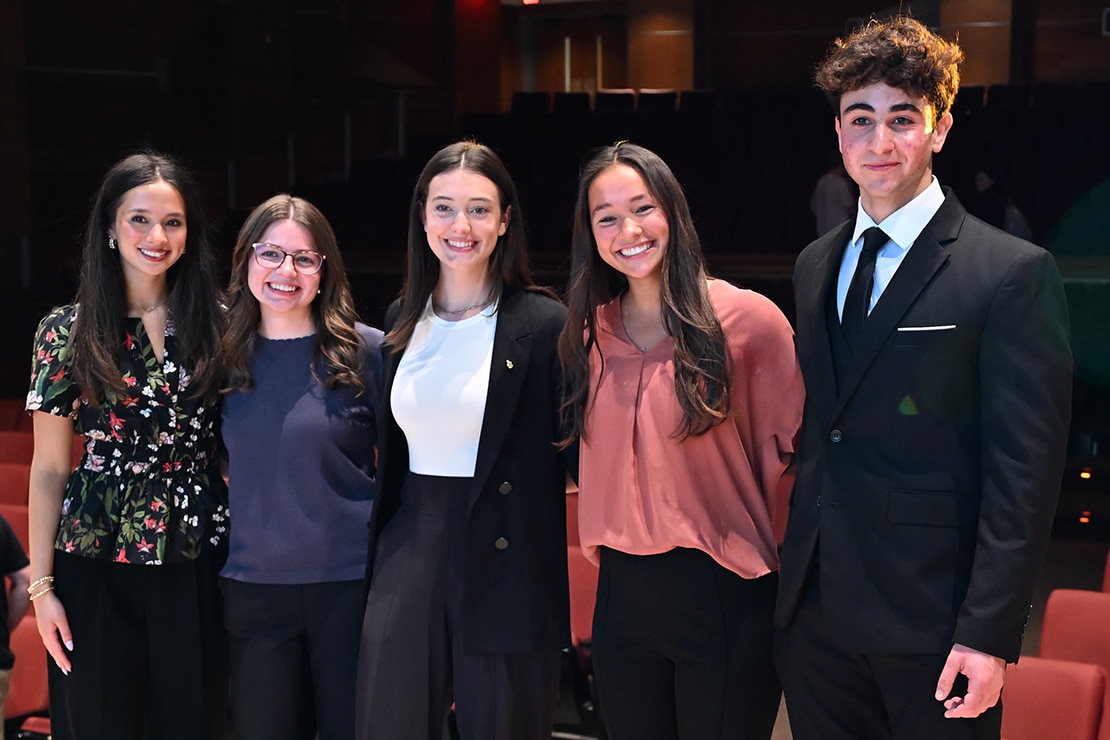
These finalists also expressed sentiments about the competition that echoed Donahue and Newman’s: it’s a unique opportunity to push oneself, and the payoff of skill and confidence is a net gain.
“During this experience I learned that, even though I never considered public speaking a strong suit of mine, I learned that in life you’re going to be given opportunities, and you should still try your hardest and see what happens,” said Soudry, the overall winner for spring 2026 and the winner of the student/popular vote.
Even though none of the semester’s finalists were CCI majors[M(1] , communication is a soft skill highly sought after by employers in all industries, which is one of the reasons a public speaking course is required by UT. The competition can have such a powerful impact that the contest’s director, School of Communication Studies Lecturer Kelly Phillips, said two of this year’s contestants decided to minor in communication studies.
While the speakers are the stars of the competition, such a huge event cannot exist without a team of people to produce, judge, and manage it. Phillips, who stepped into the role of director of the contest in fall 2025, said she was delighted with how the entire contest and final evening played out this spring.
“We had some incredible speeches. I hope that the students in the audience are all inspired by the voices on the stage. I believe this is a huge opportunity for our students to develop as public speakers,” she said.
In addition to the faculty and staff who assisted with the event, the communication studies honor society Lambda Pi Eta took over emceeing for the second year in a row. Lambda Pi Eta President Lexi Fitch and Vice President of Marketing and Communication Lauren Hiatt flexed their own public speaking chops and kept the crowd entertained between speakers.
It wouldn’t be a competition without judges, with the final evening judges being:
- School of Communication Studies Associate Director John Haas
- CCI alumna Lacie Hyder (’10, ’12)
- Assistant Director in the Office for Campus Culture and Community NaQuaina Moore
- CCI alumna Suzanne Shelton (’89)
Phillips also noted there’s a long list of others who made the competition possible, ranging from spring 2025 McClung overall winner Emma Adams, who gave the keynote speech, and numerous others who assisted with preliminary judging and event management.
“At the end of the day, it is always my hope that, when asked to say a few words, our Vols will always share their voices,” she said.
.